- Headwords26,500+
- Searchable word forms569,000+
- LanguagesLatvian + 4 translations
dict.lv is a free online Latvian dictionary built by DeepSoft. Type a Latvian word in any form — or a word in English, Russian, Ukrainian or Lithuanian — and get its translation, grammar, definition and real-life usage on one page. It runs in any browser with nothing to install, and it shares its database with our Latvian Dictionary app for iPhone and Android.
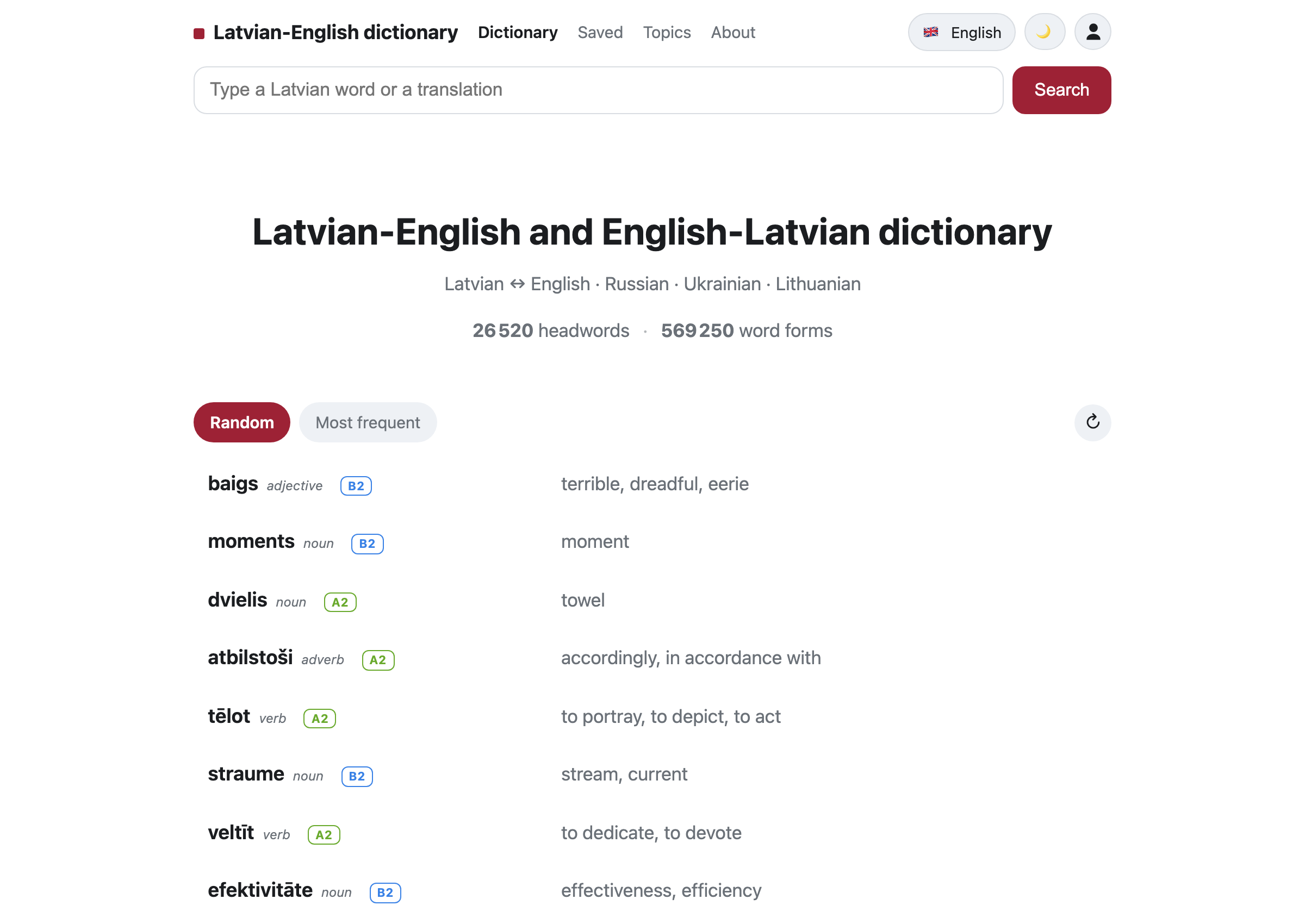
The home page: one search box for all five languages, plus random and most frequent words to explore.
Search that understands Latvian
- Any form, any direction. Latvian nouns, adjectives and verbs change their endings constantly. dict.lv indexes more than half a million inflected forms, so dziesmām finds dziesma and dziedāju finds dziedāt. It works the other way too: type song, песня or пісня in your chosen language to find the Latvian word.
- Diacritics optional. Searching for arzemes finds ārzemes, so you can look words up from any keyboard.
- Ordered by frequency. Every headword carries an estimated CEFR level (A1–C2), so learners see the words that matter first.
Everything about a word on one page
Each entry starts with the essentials — part of speech, IPA pronunciation, declension or conjugation class, and the translation — and then opens into tabs:
- Inflections — the full declension or conjugation table.
- Definition — the Latvian definition from Tēzaurs.lv, translated.
- Related words — synonyms and near-synonyms, each linked to its own entry.
- Examples — real sentences from recent Latvian news with their translations, supplied by our news app News-News.Zip.
- Translations — the word in all four other languages at once.
- Word family — the word split into morphemes, and every word built on the same root.
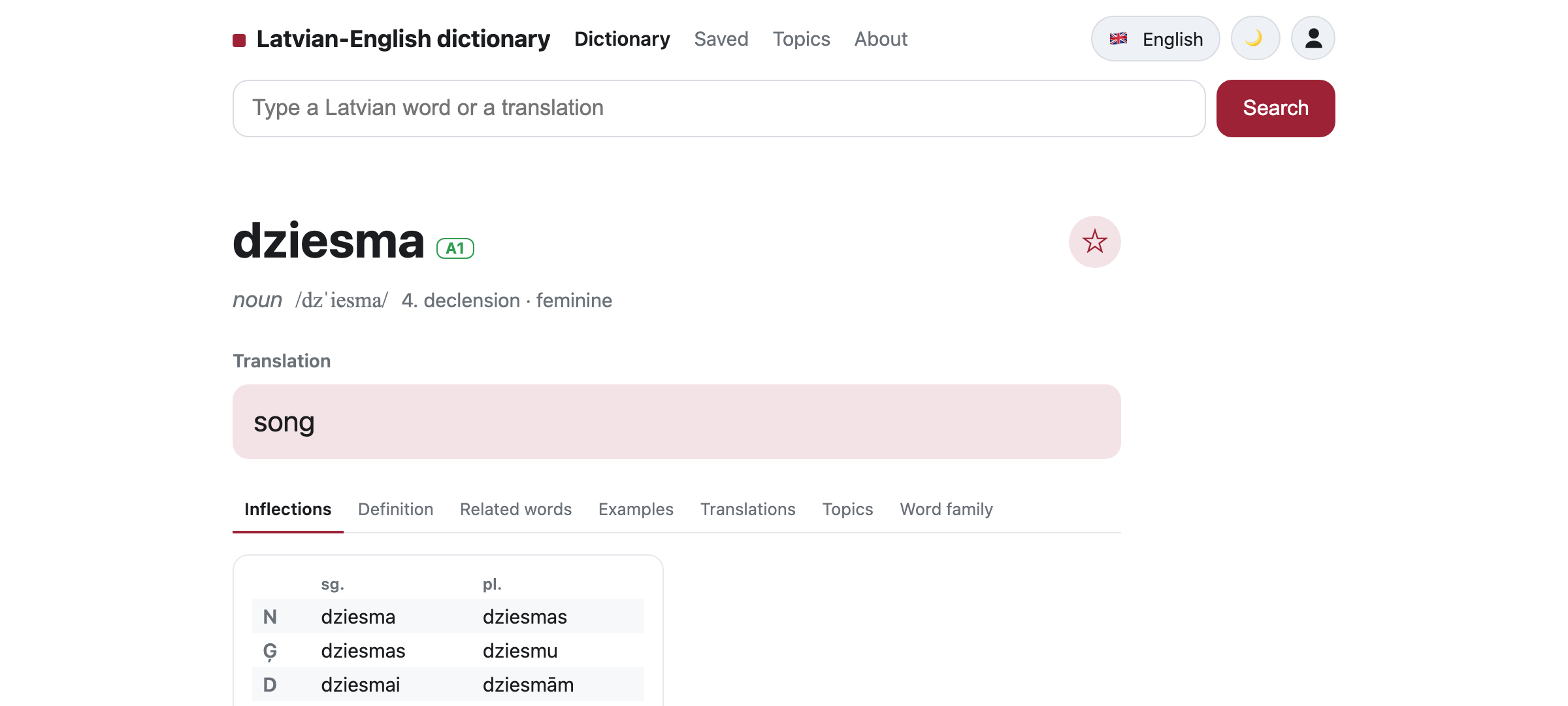

A word page: the declension table, and the word family — dziesma (song) shares its root with dziedāt (to sing) and some thirty other words.
Topics, saved words and flashcards
- Over 40 topics — from food and travel to birds, countries and chemical elements — each filterable by CEFR level and sortable by frequency or alphabetically.
- Save as you go. Star any word, or add a whole topic to your flashcards with one click, then study in a quick review session.
- No password to remember. Without an account your words stay in the browser; sign in with Google or a passkey, and your named lists sync to every device.
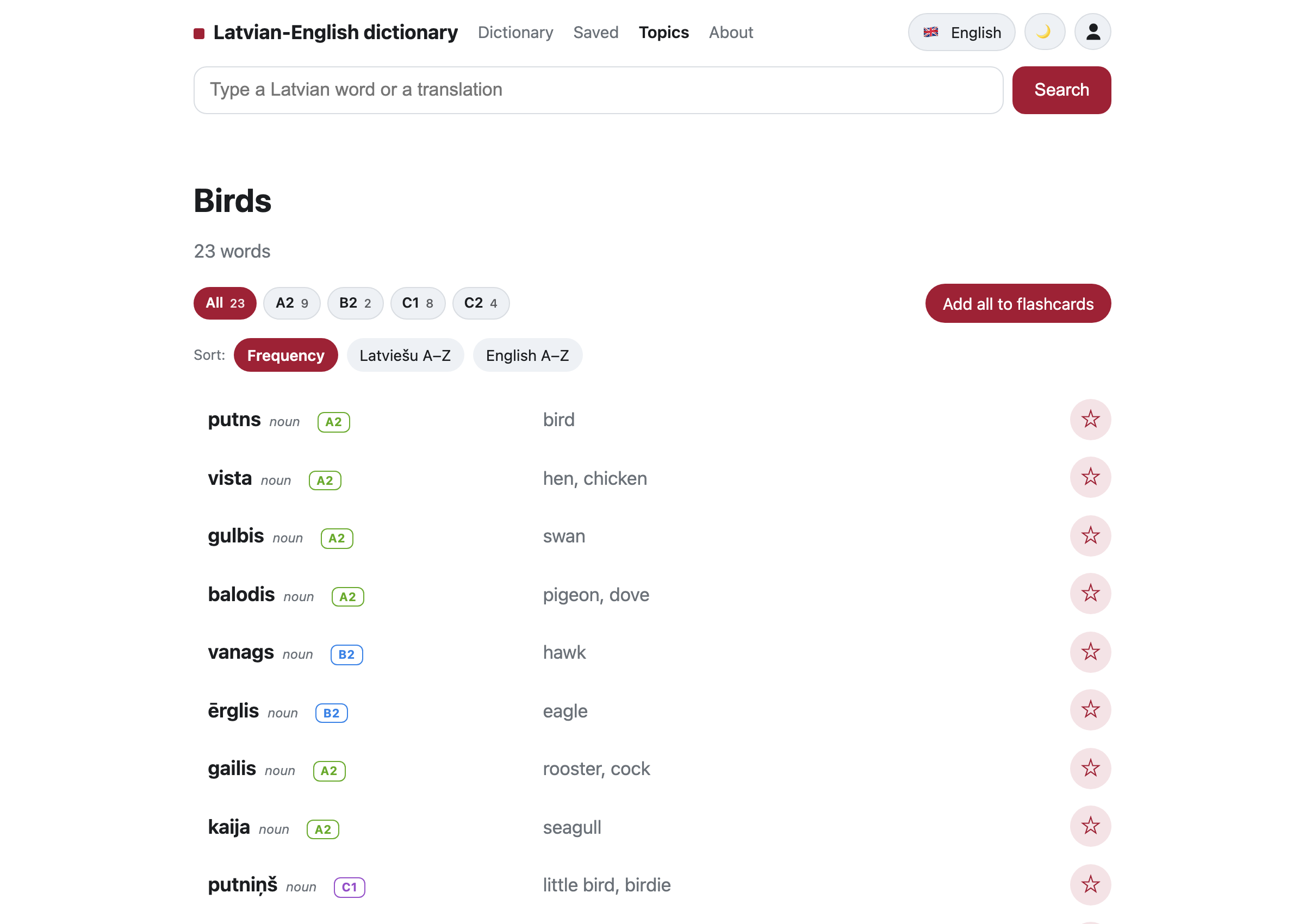
A topic page with level filters, sorting, and one-click flashcards.
Five languages, one switch
A single language switch — Latvian, English, Russian, Ukrainian or Lithuanian — changes both the interface and the translation shown on every page. Each language also has its own entry point, so the site works as a Latvian–English, Latvian–Russian, Latvian–Ukrainian and Latvian–Lithuanian dictionary at the same time. Light and dark themes follow your system.
How it is built
- Server-rendered. Pages are built on the server with Perl and XSLT — the same stack that runs this website — so they load fast, work on slow connections and are fully indexable. JavaScript only adds the interactive parts: tabs, saving words and flashcards.
- One database, three products. The dictionary is compiled into a single SQLite file that powers the website and the iOS and Android apps alike. Updating the site means dropping in a new file — no code changes, no downtime.
- Modern sign-in. Passkeys (WebAuthn) and Google sign-in instead of passwords. User lists live in a separate store, so a dictionary update never touches anyone's saved words.
- Open data. The lexical data comes from open sources — Tēzaurs.lv, CLARIN-LV and DLMDM — and is published under CC BY-SA 4.0, with every source credited on the site.
Also on your phone



The same dictionary is available as an app, Latvian Dictionary (Vārdnīca), for iPhone and Android. It keeps the whole database on the device, so it works fully offline — handy when travelling — and adds flashcards with smart review and 30 thematic decks.